|
The Colosseum & St. Augustine & MASONS |
|
A Monumental History |
|
The Colosseum & St. Augustine & MASONS |
|
A Monumental History |
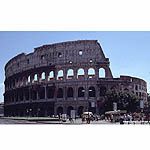
The Colosseum IS what so many
view all other monuments to be, yet are not - the utter
symbol of death, torment and mindless suffering. It is THE
memorial to absurdity. Designed
so perfectly for its function and so wondrously in its detail
and beauty, the memory it recalls
of human destruction and murderous abandon repulses us all.
Here is the anti-monument, the building
which can never crumble away to nothing or be forgotten.
Nevertheless, it is a monument.
Having said all that, it stands as a
memorial to popular beliefs because there
truly is no evidence that the Colosseum - or any other Roman
amphitheater - ever saw human to human
combat or Christian martyrdom. These structures were originally
large stages for the public display of
animals, sporting events and shows. The popular concept of
Christians being eaten by lions comes
from stage productions like George Bernard Shaw's Androcles
and the Lion, and also because in 1744 the
Colosseum, which had become Church property, was consecrated as
that kind of legend. The
idea that gladiators battled to the death in this arena comes
down to us from a single mosaic found in Rome.
However, such combat did take place - if only in mock format -
during the days of Etruscan rule,
some one thousand years before the Colosseum was ever conceived
of. Nevertheless, as we attach meaning
to all symbols, so we have done to the Colosseum.
For our next visit we do not
leave Rome, but we do leave the centuries and cultures far
behind and move on to the 14th century. Much had transpired
since the Colosseum, important changes
having occurred and taken hold. The two most important changes
were in 1) technology and 2) culture. The
first concerns how monuments were viewed and crafted. Marking a
grave was not
a normal thing to do until well into the Roman era. Oddly
enough, as is evident in some African
cultures today, people just 'knew' where grandpa was buried.
How accurate those memories
were, and are, seemed of little importance. Moses' grave was
unmarked because the Bible
wanted to stress the notion that even the great prophet
returned to the earth in the way all men
did at the time. Headstones were unheard of and the term
monument referred strictly to structures
of community significance. As people slowly prospered and the
meaning of individual life grew
in importance to a level of being a community issue, mounds of
rocks began appearing all over the world. This
was for several reasons. The first and foremost was to create a
natural vigil against
scavenging animals. The second was to properly mark the spot
for cousin Fred who might have forgotten the location
of Uncle Tadius' grave, so that when absent family members
returned from far away crusades - or wherever -
they knew where Uncle Tadius was laid to rest. The third reason
is of great interest to the
human response to death itself, that death is but a gateway to
an eternal life. Before the outbreak of
Christianaty, it was rare to think a common man could enter the
kingdom of the gods. Suddenly, everyone
was getting into the act, and lives on in our modern cemetery traditions:
Gravescaping. We see it today very much in Hebrew
cemeteries, but you can see it everywhere. If you sit
quietly by and watch people visit a grave, it is not uncommon
to observe them pick up a small
stone or pebble and place it on the grave or on top of a head
or footstone. In a manner
of speaking they are saying, 'I was here.' It stems back to
when we 'had to' cover shallow
graves to ward off animals and birds, but it has developed into
Visiting Stones, flowers, vases,
eternal lights and full ceremonies at a grave site. But the
paramount reason for it
stems from changes which occurred during the 4th to 9th century
A.D. The tale is much too
long to tell here, so I recommend that you read a book by John
Cahill titled How the Irish
Saved Civilization. It's a short read, so do it.
Being brief, though, as the Roman
empire fell during the late 4th century, something
very wonderful happened. A man known to us as Saint Augustine
wrote a book
called Confessions. It was wonderful because no
literature up to that time had ever
written in the first person. Scholars as well as everyday
people saw themselves as part of
a family, tribe, community or race. Augustine's single book
changed all that forever!
Along with this monumental event, massive cultural alterations
occurred due to the fall of
Rome. People had no authority to turn to except to each other
and themselves. What happened,
in a nut shell, was that people forgot how to read and write
and bathe and perpare foods - civilization was lost.
Or maybe purged is a better word for it. When things did start
to come back together,
people began to read Augustine's Confessions and
encountered what it was like to be a young
African man from a very 'I' point of view. This subjective view
point, along with the
efforts of Saint Patrick and others, slowly brought Europe back
to being civilized.
But, my goodness, how things had
changed for the everyday man.
Augustine has had a remarkable impact
on civilization, right up until the present day. He was a
clever man
who knew how to represent truthful concepts while living in an
age of superstition. He was the first to
look inward for answers, not in an eastern, mystical manner but
in a refreshing way, into the conscience. When asked
the definition of Time, he replied, 'If you do not ask me, I
know what Time is. If you ask me to
explain Time, I can not.' Merely the asking of this
question by sailors required using precision instruments
to guide them across oceans and thus it lead to the creation of
modern clocks (which eventually lead to
the 18th century American train time schedules, dragging the
rest of us into the march of Time)
and markedly signifies the mind shift that occurred due to this
unique Father of the Church. Augustine
formulated Time as Memory: the Past; Attention: the present; and
Expectation: the Future. These are
all human functions imposed on whatever time it is.
Augustine - as J. B. Priestly commented in his gem
of an essay-book, Man and Time (Crescent Books, 1989 reprint
of the Aldus Books, 1964 original)
- took mankind from a culture where time just cycled with the days,
months and years into a culture
where it was linear, progressive and ever moving forward, aka History.
Furthermore, the monument builder
underwent a transition. Ironically, he
reverted to what he originally was in moving from the construction of massive
structures to individual grave stones. From the start, a monument
builder held a
position. At first, he was an appointee to a king or court or
government administration.
Usually a male (but not always, and there are too many to name and
too many lost to
history to account for), this person then commissioned an architect
who in turn
commissioned a stone cutter, who probably had an army of stone
cutters behind him.
This was the way it was done until the fall of the Roman Empire when
it took a curious
turn. The entire 'bureaucracy' became a a union or fellowship. Kings
did not appoint
just anyone anymore. They had to find a 'Mason.' Masons were lonely
types, though
very busy people, who guarded their secrets of stone cutting and
assembly and made
out pretty well because of it. Such men built the great cathedrals of
Europe and most
likely everything else which lasted for a goodly time. They hired
other Masons for the
design work and seemed forever to have encouraged the kings to gather
up all their
servants as the laborers needed for the actual work. Along with this
shift came better
technology for making tools. It is a good guess that since the
monument builders were
very much singular people, their tools had to be superior to those of
their predecessors.
This is apparent when we look at the carvings found on the pyramids
and right up
to the time of the Masons, and then look at the work afterwards. It
would appear that the
ancients had nothing more than simple chisels and mallets for such
undertakings. Suddenly new
chisels, pointing tools, bullards, hammers and jointing tools of all
kinds had sprung into
being as the Masons took over. And, apparently, the Masons spent all
their time developing
tools and small innovations to them. I say this because from the time
of the Colosseum until
St. Peter's in Rome, only two structural changes had come on to the
scene - the Dome and the
Flying Buttress. And the latter was less an invention than a response
to necessity!
Our second change - or development -
was a cultural one. People not only began placing
pilings at the grave but also wanted a stone with all the trappings
of a king's
tomb. And since wealth was spreading, the tradition took firm hold.
But there are no notable
private monuments to mention here yet. Most were made of wood and
those which were
made of stone were poorly carved and often decorated with paint,
which was, by the way, a
Grecian custom. These have all faded or fallen into ruin. Later on I
will bring you to several
which were constructed at a later date on top of the ruined ones. But
they did not exist at
where we are right now in history.
So here we are in Rome, some 1,400
years later. There have been several private
monuments erected: Chartes has been completed, Venice is underway,
Shakespeare is
creating a new English and London looks like the new Rome. And for
some unknown
reason the Masons have begun to fall away. The monument builder
reverts to a designated
position, but this time he usually owns his own shop. From such a
series of shops comes a
church and monument to a faith. and also during this turnaround we
see the entrance of the
Freemasons - the monument is St. Peter's Basilica at the Vatican in Rome.
And nothing since then has been the same!
Part 1, Introduction. | Part 2, The Taj Mahal. | Part 3, Newgrange & Stonehenge. | Part 4, Nile Valley. | Part 5, Persepolis. | Part 6, Parthenon. | Part 7, Pont Du Gard. | Part 8, The Colosseum & St. Augustine & MASONS. | Part 9, Renaissance. | Part 10, Miss Liberty. |
|
|
Copyright 1992-2008 MyDrawingBoard