A Monumental History
Newgrange & Stonehenge.
The Taj Mahal is by far the most beautiful and romantic
monument there is, but the oldest monument known to us
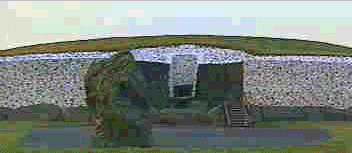
is called Newgrange, located at Newgrange in the County
of Meath on the east coast of Ireland. When it was unearthed
in 1699 by men looking for building stone, Newgrange
was described as a cave. Since then it has been attributed
to the Danes, thought to be a tomb of the kings of Tara who
lived in the first centuries of the Christian era. It is even
considered to be a remote descendant of the beehive
tombs at Mycenae. In fact, it is far older than Mycenae
and older even than Stonehenge or the pyramids. Newgrange,
celebrated in Irish literature as the Brugh (abode) of Boyne,
is a megalithic passage grave dating back to 3200 B.C., and
it offers clear evidence that a technically competent,
sophisticated Neolithic society was flourishing in the Boyne
Valley at that time.
A passage - 3 feet wide, 55 feet long and lined
and roofed with great monoliths - leads to a central
chamber with three arms. The height of the passage
varies from less than 5 feet at the front to twice this
at the chamber entrance. The chamber and passageway
are covered by a cairn estimated to contain 220,507
tons of loose stone. The whole structure was sealed with
a ring of standing stones to prevent water penetration .
The monument is a tomb for only five bodies - a mystery
in itself. At the turn of the year the sun shines
into a small opening above the passage door for 17 minutes
- a common design feature of ancient monuments and
graves. Newgrange is by far the oldest memorial structure
on earth. It is in the Boyne Valley, an area strangely rich
with prehistoric monuments.
Most prehistoric monuments like Newgrange reek
of mystery and awe. Among the most notable is England's
Stonehenge. Complete exhumations have never been achieved
at Stonehenge, so there is no evidence of it being a grave or cemetery.
There Is just one grave and It lies at the entrance to the complex.
It dates back to 3100 B.C. But that is only
its beginning. The famous standing stones we see
today were not erected until after 2100 B.C.,
at which time Stonehenge was already considered an
ancient monument! Whatever Stonehenge was
is lost to history. However, studies do indicate that
the monument was worked and crafted from generation to
generation far into modern history, and at various times it may
have been a shrine or even a market place, for all we know.
It rates as a monument simply because it is there and
stands speaking to us as a witness of a past generation,
though no one knows just what it is saying.
Part 2, The Taj Mahal. | Part 3, Newgrange & Stonehenge. | Part 4, Nile Valley. | Part 5, Persepolis. | Part 6, Parthenon. | Part 7, Pont Du Gard. | Part 8, The Colosseum & St. Augustine & MASONS. | Part 9, Renaissance. | Part 10, Miss Liberty. |
|
|
Copyright 1992-2008 MyDrawingBoard