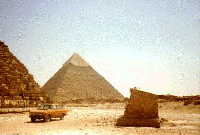
A Monumental History
The Nile Valley - and history's very first Epitaph
Rising high above the Nile Valley in the present
suburb of Giza stands a monument so famous that way
back in the first century a Roman historian thought
it to be the symbol of a man stamped upon this planet by the
gods - I'm talking about the Sphinx. With the body of a lion
(the symbol of bravery and courage) and the head of a
man (intelligence), this structure, imposing as it
is, is the gateway to a far more complex
and wondrous monument - the Cheops pyramid. Also
known as the 'Great Pyramid,' it is the tomb of
Pharaoh Khufu (the Greek form of his name is
Cheops). Both monuments date back to the 26th century
B.C. Close by are the pyramids and tombs
of two later kings, and among them stand many other smaller
pyramids. Thus this area has come to be called both
the Valley of the Kings and the Valley of the
Pyramids. Here, awe is complete and justified.
The Great Pyramid stands 450 feet high. It is
constructed of more than 2 and a half million blocks
of limestone which were quarried nearby, weighing on average
over 2.75 tons. The largest blocks
weigh over 16 tons. And inside the pyramid the
granite ceiling above the king's resting chambers
is over 56 tons. Just with the Sphinx and Cheops pyramid
alone we are looking at over 7 million tons of stone erected
without any modern machinery!
Unlike Newgrange and Stonehenge which are filled
with mystery and speak little about the people who
designed, built and used them, the
pyramids are a rich conduit between the ancient
Egyptians and ourselves. History is said to have begun
in the Nile Valley, and that is very true because
racial memory relies completely on monuments. China
was not just an old, established kingdom when Newgrange
was erected and ruled the world's largest empire when
Stonehenge was just breaking ground: it was also
fully literate when the West was just starting to use
hieroglyphics. But China's oldest monument is the
Terra-cotta Warriors of Lintong which date back to
just 210 B.C. We all know something happened long before
then but haven't a clue what it was. And even
if we had, no one from that time left us
any messages in stone, metal or terra-cotta. However,
the pyramids speak directly to us and moreover they
tell us from where we came. The Sphinx tells us about
an emerging race of people who had intimate
connections with their prehistoric beginnings.
The lion speaks of the jungle and is thus an indirect
pointer to the evolution of man from beasts. It also
represents the Zodiac symbol of the sun - Leo. Many
want to assert that the Sphinx was built during the age
of Leo some 12,000 tears ago. But that is very controvesial
and the stone itself, being milled very much like the pyramids
behind it, suggest a much later date. (Unless the pyramids
behind it were crafted by learning from the Sphinx?) If we
want mystery and old age, we need only look to another sphinx
built much earlier, around 4,200 BC, the Lion of Kea.
However that structure is not identifiable as a "monument" and
lies beyond the context of our story.
The Sphinx wears a headdress, a royal symbol and on its
forehead is a cobra. Most impressive is this first use of an
epitaph! Carved below the imposing head is a story
about how the king lived and died. The Sphinx lies
as if guarding the Cheops pyramid and today it is the
gateway to the Valley of the Kings.
All this speaks to us and it created the memorial
tradition which we still hold to: permanence,
communication and vigilance. Man was still very
much a creature of a jungle, but then he faded quickly
into an endless desert. Man no longer had the
protection of trees and the forest, so he had to use the
stone of the desert for protection. It was a time of evolving
and change. Not sensitive enough to create a Taj Mahal,
but brave enough to lay the foundations for it.
Every monument, including the Taj Mahal, has
as its 'foundation' the pyramids. No course in
architecture or the study of monuments begins without
an examination of them.
Until the time mankind began to use the written word,
monuments were the vehicle for passing information
from one generation to the next. And to this day
a monument speaks in all languages. Monuments speak
from the mystery of prehistory, with the eminence of the
pyramids, and from the base emotions of sorrow, tolerance,
remorse and remembrance . . . and with grandeur.
Such as the one at our next stop, Persepolis, Iran, in 522 B.C.
Go to:
Part 2, The Taj Mahal. | Part 3, Newgrange & Stonehenge. | Part 4, Nile Valley. | Part 5, Persepolis. | Part 6, Parthenon. | Part 7, Pont Du Gard. | Part 8, The Colosseum & St. Augustine & MASONS. | Part 9, Renaissance. | Part 10, Miss Liberty. |
|
|
Copyright 1992-2008 MyDrawingBoard