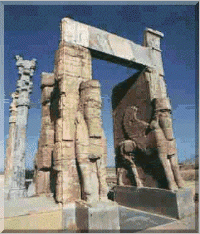
Persepolis... and the word MAUSOLEUM.
A Monumental History
Persepolis... and the word MAUSOLEUM.
The ruins of Persepolis that survive,
massive though they may be, give only the faintest
hint of the wealth of this ancient seat of government.
The Greek historian Plutarch sheds some light on
the matter when he said that Alexander the Great,
who conquered Persepolis around 330 B.C., needed
10,000 mules and 5,000 camels to carry away the
spoils. Those treasures belonged to the Achaemenid
dynasty of kings, and Persepolis was just ONE
of their royal capitals! It is often said that
the splendor of Athens and of all Greece, and later
Rome, were just copycats of Persepolis. And there
is good evidence to back up that statement. In
that sense all of Persepolis is a monument, but
there is more...
Naqsh-i Rustam is a solid, wide cliff near
Persepolis and holds four tombs belonging
to the Achaemenid and later Sassanian dynasties.
The inscription on one tomb identifies it as that of
Darius the Great. The others are thought to be
those of his successors, Xerxes I, Artaxerxes I,
and Darius II. The tombs are carved to depict
the facade of a palace, and the bas-reliefs show
figures supporting a king on a throne while he
seems to be worshipping the Zoroastrian god Ahura
Mazda. In front of these tombs is the Cube of
Zoroaster, a 40 foot high building with a single
inner chamber and an outside stairway. It is thought
to date from the time of Darius the Great and may
have been a fire temple.
What brings this monument to our attention,
besides the enormous wealth and skill needed to cut
away an entire cliff, is that all the carvings on it
tell vivid stories, without any writings.
Iran sits between India and the great societies of
the West. In India massive shrines and temples were
being built in honor of the gods and human fertility.
These buildings were covered with carvings of all
sorts, sometimes to the point of being wholly
congested! But not one word explains anything -
the figures do it all. Back in the West we find
less emphasis on figurines and more on emotional
responses and words. Persepolis is the refinement
of the Indian method and the probable precursor of
the Western method. Not only is Naqsh-i Rustam
an awe-inspiring memorial, it's a clear monument
to the art of communication.
Meanwhile over in a small kingdom named Caria
around this time in 353 B.C., a king of no note
- King Mausolus by name - died. His wife, and sister,
Artemisia, just fell to pieces over her loss. After eating his
ashes for two years she finally died of a broken heart.
However, during those two short years she gathered the
best architects and sculptors to build a sepulchral monument
for her beloved at Halicarnassus. It was tagged Mausoleum
in honor of her king and the entombed man. It's a similar
story as the Taj Mahal except this monument was
built out of sorrow for the loss of a king, not a queen. And,
also like the Taj, this monument was esteemed for over
1,000 years as one of the seven wonders of the world.
Until the Crusades did a number on it. The knights of
St. John, to be exact, in 1402. When it was excavated in
1857, the area of the base, which was cased with marble,
was measured to be 230 by 250 feet.
Go to:
Part 2, The Taj Mahal. | Part 3, Newgrange & Stonehenge. | Part 4, Nile Valley. | Part 5, Persepolis. | Part 6, Parthenon. | Part 7, Pont Du Gard. | Part 8, The Colosseum & St. Augustine & MASONS. | Part 9, Renaissance. | Part 10, Miss Liberty. |
|
|
Copyright 1992-2008 MyDrawingBoard