Lettering; More Than Meets The Eye
You will never come across a gravestone without lettering on it unless it is a pre-need – a stone awaiting lettering - or a grave of unknown contents or a secular grave such as that of a priest, brother or nun. Not to identify a grave defeats it’s symbolism. It serves to submit fully to the Grim Reaper. It says that we are nothing, never were anything or any person, and nothing within the world of humanity has significance. In short, an unmarked grave is a lie.
To record the contents and to offer clarity to the message of a monument, lettering is the foremost medium. From time immemorial until just very recently, the method for cutting lettering into all stone was called V-cut. This is a chisel fashioned cut. If you place a chisel to stone and tap it with a mallet the cut produced is in the shape of a V. Variations of this V have been employed to create diversification. Raised, square, V and counter-sunk; you can count them on four fingers, yet until the advent of sandblasting in the 20th century, the V was all we had. Now it’s how much imagination we can muster that cuts lettering into stone and bonds it to bronze. For old-time sake the term V-cut remains and speaks more to the depth of the letter, not the manufacture of it.
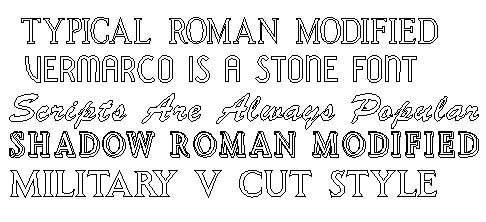
Along with this revolution both in lettering design and computer font applications, fonts, the computer style letters such as raster and vector, presently offer families and their designers unlimited forms of expression. The age-old Roman Modified text will remain with us because of its beauty, but variations of it as well as new text forms are appearing all over our cemeteries.
It is impossible for me to offer you more than a handful of lettering styles, so I will post the more common. A search on the Internet can yield a treasure trove.
The style of the lettering can enhance the message of a memorial or it can distract from it. An interesting letter form is delightful to come across.
|
|