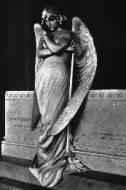
The Garden and its Rocks
Typically, and thankfully, the memorial park is quiet and peaceful. It’s not a place to expend energy, to play, conduct business or congregate needlessly. Many steal away to enjoy their lunch breaks among the gardens and buildings, stones and fountains. I have spent several days off finishing a good book under the maple trees at Pinelawn Memorial Park, both reading and typing on a laptop; and I know I‘m not at all alone in that pleasure. Beyond doubt, especially around holidays, you will sometimes be surprised at how many people make the most of the community burial grounds.
The popular belief that suggests the
present generation has scorned graveyards is a myth to anyone who
visits on any holiday. Save Vet’s Day and Memorial Day. Both
holidays at Vet’s cemeteries see visitors, however, making a
comparison with a civilian cemetery is ridiculous. For example, of
the 200,000 sites at the Long Island National cemetery, less than
15,000 of those reflect interments from the present generation. Still
graves reflecting the Korean War and the World Wars can find a
bouquet or two on them every so often. In major and old cemeteries
people gather to visit while students, tourists and researchers are
escorted on guided tours. Some famous cemeteries harbor so many
tourists that a visit to a loved one’s site can be down right
annoying. Some very famous burial grounds in Europe and Egypt pile on
merchant booths and side shows to ridiculous extremes. It is
sometimes eerie the way famous cemeteries will merge
entertainment with the management of an active burial ground.
Hopefully, you or yours are not fretting among the rich and
famous. Instead, for your more subdued entertainment, I’ve
included some inspirational verse, and a tale or two in Part III.
What most people do not gleam is that there lives an abundance of communication clamoring all around them. There is music, tales of drama and tragedy. There flows inspiration and urgency. There is gracefulness and utter despair. Calls to heavenly bliss and quiet wisdom meant for all ages in all generations. It’s right in front of you and so many, even those who take the tours at those upper-crust cemeteries, walk right by it. It’s carved directly into the rocks which fill the garden.
A monument, whether it is a simple marble, military monolith or a flush bronze marker or a small granite die squatting atop a rock-pitched base or a mighty mausoleum or a feat of immense human industry like Stone Hedge or the Taj Mahal, serves three functions. 1) It marks the site. 2) It is a legal document. And, 3) It serves to refresh the memories of the living about a life now fully completed. In the case of a civic monument it marks values and/or events, serves as a commitment of the community or society and refreshes our memories concerning an event or values expressed in the structure. The Statue of Liberty is a monument.
A grave marker, whether it be a stone, metal or natural earth formation (like a cave) often rest atop the grave and thus the earth. Landscapes and the earth below them are often fluid, as anyone who tries to build extensive piping systems on islands of sand – like Long Island, N.Y. – can attest to. Or anyone, like an archeologist, who is required to exhume ancient graves, must contend with. Modern cemeteries, therefore bury close and lay boxes head-to-head and foot-to-foot. Where an upright monument is planned, a four to five foot by two foot retaining wall is placed along and at the head of each row of graves. This serves three purposes. It economizes on space. The ‘beam’ as it is called, acts as a permanent footing for stone work, and, it locks entire sections of graves together, thus avoiding underground drift. Graves marked in today’s cemeteries are likely to remain put for thousands upon thousands of years. Because of the beam the grave markers properly serve their first function of marking a location.
The second function comes as no surprise from the far reaches of history. A grave marker is a legal document. For the longest time gravestones were called ‘ledgers’ because they recorded information about the deceased upon it. As these ledgers grew in dimension and eventually developed into a large slab atop the entire grave to ward off robbers, then evolved into the grave covering it is presently, any grave marker now serves that ancient purpose. Every court of law, all major institutions (Social Security, IRS, et al) recognize a grave stone as proof of a life now completed. Which brings more responsibility upon the cemetarian to demand that the stone cutter be exact when inscribing names, dates and sayings into the marker. Up until recently, very few cemeteries – especially secular ones – would even permit nick names or verse which might be misleading. As an example, the following are three epitaphs off three monuments found in an old cemetery in New England, USA. The first reads: John Samuel, Born 1774, and Died 1852. The second reads: Lisbeth Samuels, Born 1778, Died 1860, Wife of John Samuels. The third reads: May Hapswood, Born 1784, Died 1859, Should have been John Samuels’ Wife.
Suggestions and suppositions are tough to get carved in stone nowadays.
The third function you are employing at this very moment: the revitalizing of the fact of who this person was and all he or she meant to you. And, perhaps most importantly, though over looked, a direct statement saying that person is no more. He or she is now resigned to eternity as you have the traditional honor and rite to pay your respect to that profound mechanism of God’s law. Life divides us from the dead, a monument is the division between the living and all future life.
And a monument speaks directly and specifically to the generations not yet born.
Centuries from now, long after that much talked about end of the world comes, long after the English language is lost to time and maybe even after a long and chilly Ice Age comes and goes, that stone where you just placed a gift and offered a prayer from your hopes and faith, and reflected upon a memory or two, that marker will speak volumes. And will promise to do so from now until forever.
Would you like to be able to read it? Would you like to know what the other markers around you say? Would you like to look at an old gravestone and be able to read it? You certainly came to the right person.
|
|