Reading Monuments
The usual reason to read a monument is
to find a grave. However, once you found the site and now want to
listen to what the stone at the site and others around you have to
say, you should pull back from seeking a name or section numbers. To
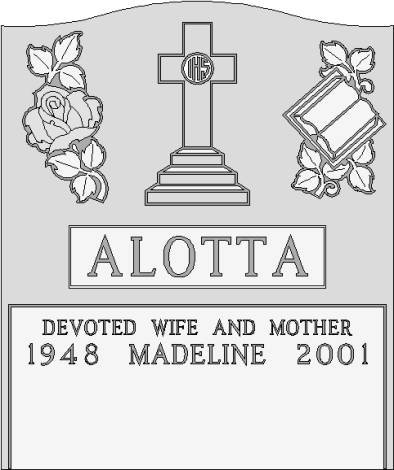
read a monument, such as the ALOTTA monument, we begin with the
material and the shape.
The monument is made of gray granite.
Which tells us this is a serious placement set to remain for
eternity. It has a polished finish which indicates refinement,
dignity. Polished stone also indicates inner strength because the
closed (polished) surface forms a barrier against mildew, sap and
settled water residue.
The shape is tablature with a
serpentine top. Like a pillar
it stands erect, proud and is meant to be read like a book. Above all
else – at the top – no matter how immovable this
granite might be, how dense and tough the stone, a ‘serp’
top indicates the determination of the human creative forces needed
to cut hard stone. The sweep of the ‘serp’ is a symbol of
the freedom of the spiritual being that can now move in any fashion
desired, unrestricted by natural forces.
The surname is predominant and sets
the eye. A good
designer will bring your focus to the beginning statement of
the stone’s revelation. Enlarging the surname, placing it in a
whitened panel (called a steeled panel because it is whitened by
spraying the polished stone with a steel shot) positioning the
surname as closely as possible to the stone’s center and
employing it to separate the design work from the lettering, your eye
naturally rests and starts at this location.
Thus begins the message carved in
durable rock, fashioned by
modern technology: We wish to tell the story about a member of the
Alotta family, Madeline by name, born during the year 1948 and died
during 2001, a wife and a mother who was beloved and remembered. As
it is natural for the eye to drop while reading, it is just as
natural for us to raise our eyes back up to the design work when
reading is stalled. Coming directly up we encounter a Christian
symbol. There are 3 steps leading to the cross which represent the
three virtues, faith, hope and charity. It is through these
virtues that we climb the path through the church and eventually find
Christ –the HIS- in the nimbus or, as it is better known as,
halo. Thus, this is a Catholic memorial. Madeline was a baptized
Catholic. A designer can not predict if your eye will move to
the left, as is the case for most left-to-right readers, or to the
right. However, there are two memories this designer cares to relate
concerning Madeline and the Alotta family. On the left is a
carved rose. It is big and very deeply carved. A rose like this
in stone is a symbol of very deep and committed love like that shared
between a married couple. Above and below the rose are leaves in sets
of three. This, in a Catholic setting indicates the Holy
Trinity. But with a twist. Notice the top pair of leaves,
pay attention as to how the points of each leaf is facing. If you
allow your eye to flow with the top three points you will move in a
circular fashion. The leaves form a circle, a bold statement that
there are three persons alive, moving and visible in this
trinity. The Alotta family (or at least their designer)
is carrying on quite a religious conversation. Now look at the bottom
set of leaves. Your eye can not form the circle because one
point stops you. Instead you form a triangle. In this setting the
triangle represents the Trinity as the all-knowing God of the
Bible. The Alotta family loves deeply and profoundly. Madeline,
her husband and family were (and still are) very lucky and loving
people. And there’s more to them. On the right the
story of the Trinity rests in the background to a book. It is
not a large, imposing book so we ought not think it the Bible. Rather
it shows education. Perhaps founded and resting upon Catholic
teaching, but learning nevertheless. This family values love and
education as tools to gain oneness with Jesus through the teachings
and practices of the Holy Mother Church. The suggestion that her
place in heaven is assured, seems obvious.
The entire focus and message is one of life, spirituality, and about
the rewards promised to those who uphold virtue. The Grim Reaper
often rattles our foundations, yet can not break our bonds with immortality.
Epitaphs and Endearments are two
different sayings. The line
BELOVED WIFE AND MOTHER found on the Alotta monument is not an
epitaph. It is called an endearment. An endearment addresses
individuals; usually in an ‘endearing’ fashion. To Know
Him Was To Love Him, Beloved Son, Kind And Good Doctor, are all
endearments. They revitalize your memory of the loved one. Epitaphs
make declarations. They are final words on the matter. In
God’s Care, Always In Our Hearts, We Mourn and Lament Our Brave
Youth, Rest In Peace, are all declarations about our encounters
with mortality. The Alotta family did not carve into their stone an
epitaph. Why not? Because at this time only Madeline lies here. The
Alotta story is not finished. Most graves have room for at
least three interments. The Alottas apparently feel that a
declaration at this time would be premature. When another or the
final name is inscribed, then this educated family will say their piece.
I have included some interesting epitaphs and endearments in appendix C.
|
|
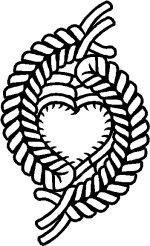
The Labyrinth, mazes, knotted rope, wandering threads are very ancient symbols of how mankind is framed by the grip of time. The twisting and turning paths all lead to the center, to the womb wherein, through sincere effort and the endurance of time, each of us returns to our maker. Usually the center image depicts God in the shape of a circle, a set of circles or a square. If not God then some lofty and often unobtainable ambition is depicted. They are often found on markers if you know what to look for. Here on the left you find two strands of knotted rope set about a heart in a Tai Chi (Ying Yang) formation. The edge of the heart is serrated to indicate a stormy but heartfelt romance. The Tai Chi layout is of mirror-like ropes to bring home the message that these two were of the same mind and reaching for the very same feelings of love; both employed opposite methods and means. Scroll work shows opposing forces which form unity as illustrated below. Thanks to Derick Earp. |
|
|
The Tale of the Talty Family
I had the honor but staggering experience of designing the DeFeo
monument – of Amityville Horror fame – when I was in my
early twenties. At the time I thought I’d never come across such
sadness; memorial designers do so often. Here’s a sad story
which begins in tragedy and turns blissfully to triumph. I’m not
one to believe in reincarnation or one who would profess the notion
on a stone in a Catholic (anti-reincarnation) cemetery, yet that is
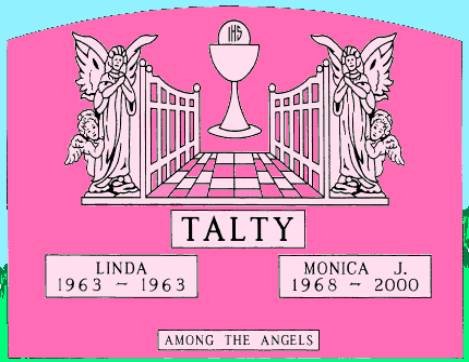
exactly what I did for the Talty family. They believed their Linda
was reincarnated as Monica 5 years after Linda died. When Monica left
for the gates of heaven at a young age also, Mr&Mrs. Talty became
convinced.
We begin our reading again with the
material and shape. This stone is pink granite, the softest of all
granites. Appropriately pink because the Talty family consists
of 3 females and one male. The oval shape is completely indicative of
the bow of heaven where the entire story is told. Taking in the
surname then moving to individual names, we are astonished to learn
Linda died at birth (actually within her first year.) Then comes
Monica in 1968, who returns to her maker in 2000. The epitaph –
Among The Angels – is a clue as to what the parents are trying
to tell us. Looking up we find a large chalice with the sacred host,
the symbol of Jesus. Whenever you see a chalice in a Christian
setting it speaks directly of the agony Jesus experienced in the
Garden of Gethsemane. However, if a host is shown, as above, the
symbolism changes to mean the Mystical Body of Christ. Again, this
stone is hinting that there’s a hidden meaning. The chalice now
means Transfiguration and it stands exalted within the open gates of
heaven. This further confuses us because the Transfiguration of
Christ is not something we gain as humans, whether we climb the path
to heaven’s gates or not. Usually, this design will hold a
cross between the gates, affixed to the pathway as a sign of entering
paradise through the virtue of Mother Church. Instead we have the
unobtainable. I can hear an angel saying, “Linda is not
here.”
And where is she? She is hiding, obviously. Behind her big
sister Monica. Linda was transfigured (reincarnated) as Monica and
now is one angel aside the gates of heaven awaiting reunion with her
parents.
Here’s a design fresh off my computer.
Begin reading at center&ldots;&ldots;.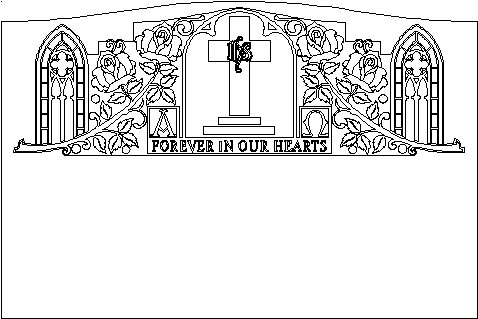
Our faith burns forever in our hearts,
that through the adherence to faith, hope and charity we obtain the
(chapel) embrace of Mother Church our salvation (the cross) and
reunion with Christ (IHS.) This is for all time (Alpha -
Omega.) Built around our faith is our great earthly love for family
(4 deep roses expressing deep love usually reserved for married
couples. Surrounded by many leaves shows a love for family.)
Affirming and standing guard is our personal honor and dignity which
is reflected by a civil and scholarly introspective (the side
chapels.) All this is engraved within solid granite which will
endure all forces forever."
A Roadway To Heaven
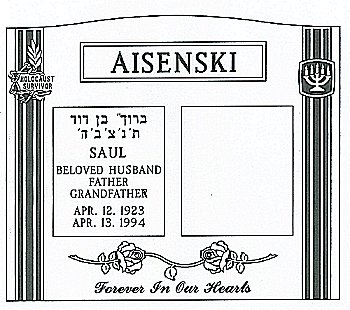
An easy read.
The Aisenski monument is completely devoted to two people very much
in love with each other and with their God. The stone is large
and formidable. Saul lived a long and rewarding life, and
enjoyed grand children. The expression of love we see here of two
very deeply carved roses, one for Saul and one for his widow, come
together in a single thought –as a single leaf – which
points at the epitaph. A saying so dear and simple.
Open top (soaring) columns are a symbol of the tie between heaven
and earth. Like a ladder, a roadway ascending into heaven. A
column’s reach is limited solely by imagination or human
resource. These columns span the entire height of the stone and
suggest an inspired, further reach. Two pillars represent the duality
resolved by the pathway between them and leading into a new life.
This monument is for two people in one spirit.
We also see that Saul’s life
endured profound suffering during his early years. The
Holocaust Survivor emblem is a dreadful reminder of man’s
inhumanity to man. That the designer chose to place it on the column
infers remarkable acceptance by Saul and the entire Aisenski family
of mankind’s situation. It is saying that suffering is very much
a part of the human quest to gain a place in the kingdom of God.
An Unfortunate Read
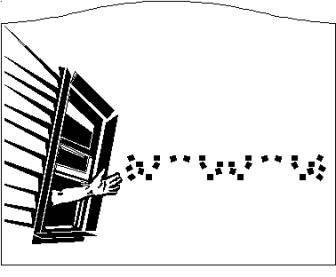 At
the archive I’ve founded and administrate, we have an option
called the Wish List. Designers in need of a design they
either just don’t have the time to draw or are at a loss of
expression will submit a project to all the other designers who are
members at the Board. This project had the contributor
perplexed and his project was for a man who had slowly lost his mind
in the last years of living. His last months were spent sitting at a
window and tearing paper up into little piles. The position of
the hand is to symbolize both reaching and throwing. Reaching,
appealing for a “hand” into a better world.
At
the archive I’ve founded and administrate, we have an option
called the Wish List. Designers in need of a design they
either just don’t have the time to draw or are at a loss of
expression will submit a project to all the other designers who are
members at the Board. This project had the contributor
perplexed and his project was for a man who had slowly lost his mind
in the last years of living. His last months were spent sitting at a
window and tearing paper up into little piles. The position of
the hand is to symbolize both reaching and throwing. Reaching,
appealing for a “hand” into a better world.
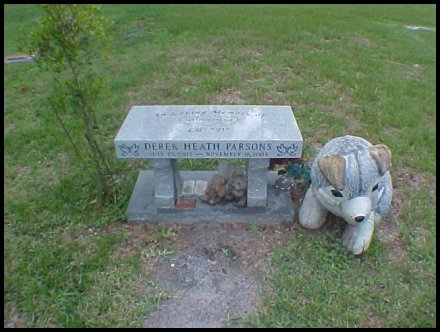 A
Boy and His Dog. This concept is remarkable because the monument
is interactive. Sit on the bench and you are transported to an
event that actually took place. You take the place of the boy whom
this work of art remembers, designed from a photo of the boy and his
dog. It is further remarkable because of the inlaid black and
dark red granite for the pet’s eyes, nose and ears. It is very
apparent from the worn path leading to the monument that what the
designer intended will repeatedly occur forever.
A
Boy and His Dog. This concept is remarkable because the monument
is interactive. Sit on the bench and you are transported to an
event that actually took place. You take the place of the boy whom
this work of art remembers, designed from a photo of the boy and his
dog. It is further remarkable because of the inlaid black and
dark red granite for the pet’s eyes, nose and ears. It is very
apparent from the worn path leading to the monument that what the
designer intended will repeatedly occur forever.
|
|