Think Before You Screw Up
 One of the largest shifts in the business of the cemetery over the
last century or more is a shift in ownership. From us to them. It is
not a drastic shift because ownership of graves and memorials moved
logically from us to trustees to them. If you research this trend,
you’ll find these shifts were mostly done to insure graves whose
owners and families themselves died off, as during famines (see Irish
history.) “In the olden days” cemeteries crowded the
churchyard and trustees were setup to care for the entire ground.
Most of these trustees are still active today, but include massive
burial grounds. Bottom line is that you do not own the grave or the
memorial. You do have burial rights usually forever in America (from
15 to 90 years in many European countries – a whole other book.)
And, of course, if you want to modify or replace the family
headstone, no one at the cemetery will object. So long as you are the
original deed holder. Once the deed holder is gone, the cemetery will
make the heirs jump through hoops to affect any change to
‘their’ grave and monument. This assures future visitors
are guests welcomed to the park to partake of it and to allow it to
remain beautiful and functional.
One of the largest shifts in the business of the cemetery over the
last century or more is a shift in ownership. From us to them. It is
not a drastic shift because ownership of graves and memorials moved
logically from us to trustees to them. If you research this trend,
you’ll find these shifts were mostly done to insure graves whose
owners and families themselves died off, as during famines (see Irish
history.) “In the olden days” cemeteries crowded the
churchyard and trustees were setup to care for the entire ground.
Most of these trustees are still active today, but include massive
burial grounds. Bottom line is that you do not own the grave or the
memorial. You do have burial rights usually forever in America (from
15 to 90 years in many European countries – a whole other book.)
And, of course, if you want to modify or replace the family
headstone, no one at the cemetery will object. So long as you are the
original deed holder. Once the deed holder is gone, the cemetery will
make the heirs jump through hoops to affect any change to
‘their’ grave and monument. This assures future visitors
are guests welcomed to the park to partake of it and to allow it to
remain beautiful and functional.
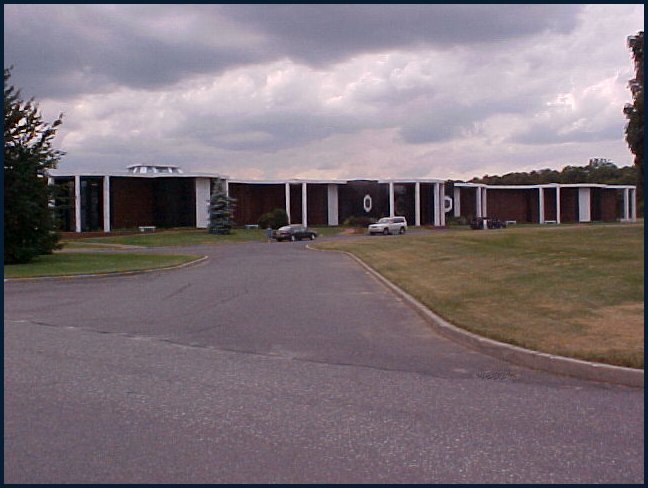
 This
trend is nowhere seen more readily than in the public mausoleums.
These structures first appeared as the modern cemetery , with all
its acreage, found itself squeezed in by a city. The oldest
that I am aware of dates to the 19th century. They can be
found in every large cemetery today. In many of these astounding and
lovely structures visitors are not even permitted to leave gifts at
all. There is no designing permitted and no epitaphs or endearments.
They are big, fancy, mortuary vaults. Inside a visitor feels
entombed rather than welcomed or at ease. A product and necessity to
the times.
This
trend is nowhere seen more readily than in the public mausoleums.
These structures first appeared as the modern cemetery , with all
its acreage, found itself squeezed in by a city. The oldest
that I am aware of dates to the 19th century. They can be
found in every large cemetery today. In many of these astounding and
lovely structures visitors are not even permitted to leave gifts at
all. There is no designing permitted and no epitaphs or endearments.
They are big, fancy, mortuary vaults. Inside a visitor feels
entombed rather than welcomed or at ease. A product and necessity to
the times.
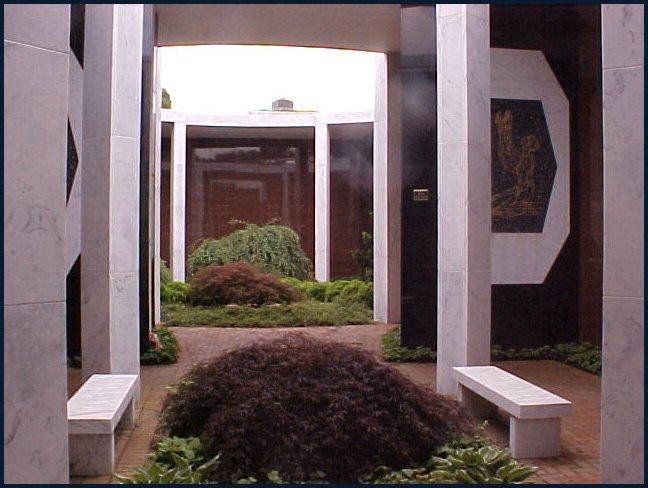
They are also convenient and sanitary, reminiscent of a chapel. So it
has benefits, especially if you’re in high heels or better than
street attire. Although I recommend against high heels even so;
notice the floor in picture, it’s common brickwork. They are not
designed by monument builders, architects get these projects and,
apparently do not confer with memorialists. Not by the looks of the
projects, anyway. The look and feel is functional, like a
modern chapel. There is very little inspiration yet there is
always lots of seating and cute little gardens. Be careful not to
create trash as there are no dispensers. Expect the air temperature
to be too hot during summer and remarkably crisp during winter. I
will give it this: the interiors are so quiet that outside noises
from trains and planes are even muffled. You can vividly hear
yourself think and, if such a place can induce you toward fond
memories, they’ll come through loud and clear. They transpose
the cemetery from memorial garden to bodies stacked around tiny,
cultured gardens. Don’t expect much inspiration when visiting
these structures. And, unless you’re a ‘thoroughly modern
Millie’ try to avoid even coming near these buildings.
 The
ancestor to these structures is the private or personal mausoleum.
The very first was built for Alexander The Great’s dad and is
today the rich man’s very own pyramid or kingly tomb.
Unlike its bigger and younger brother, these are filled with
inspiration. Most are ornately designed and you get this echo from
the Victorians that wealth boosts our heavenly reward - like
the bucks are not good enough in the here-and-now? Very few do not
excite the spiritual side of the imagination and very few are ever in
danger of ruin. They are built with forever as the goal. Few are
strictly functional. Not designed by architects, these are master
strokes from memorial builders wherein the visitor feels not like
entombed but at bedside. They are also extremely fine
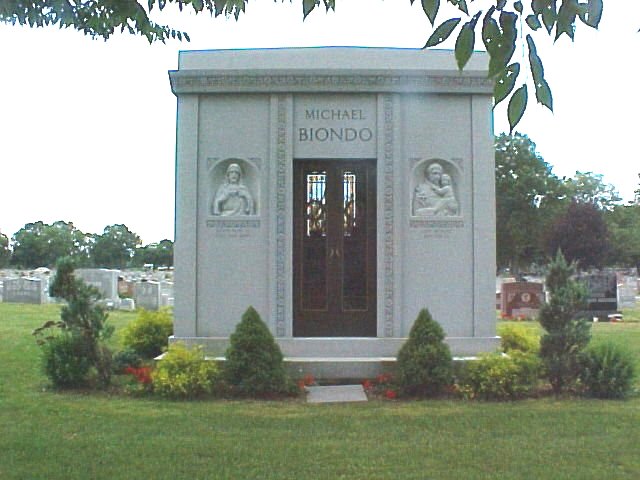
representations of their times. My family mausoleum, designed by my
uncle Pasquale, was erected during the early 1960s when functionalism
was king. Thus it looks like a box with a dramatic stained glass
window. If you return to the Victorian ones, gosh! they’re
elegant and over done with so much filigree that it takes hours to
take them all in. The mausoleum you see above was built in 2003 and
speaks to the quest for a return to classical design.
The
ancestor to these structures is the private or personal mausoleum.
The very first was built for Alexander The Great’s dad and is
today the rich man’s very own pyramid or kingly tomb.
Unlike its bigger and younger brother, these are filled with
inspiration. Most are ornately designed and you get this echo from
the Victorians that wealth boosts our heavenly reward - like
the bucks are not good enough in the here-and-now? Very few do not
excite the spiritual side of the imagination and very few are ever in
danger of ruin. They are built with forever as the goal. Few are
strictly functional. Not designed by architects, these are master
strokes from memorial builders wherein the visitor feels not like
entombed but at bedside. They are also extremely fine
representations of their times. My family mausoleum, designed by my
uncle Pasquale, was erected during the early 1960s when functionalism
was king. Thus it looks like a box with a dramatic stained glass
window. If you return to the Victorian ones, gosh! they’re
elegant and over done with so much filigree that it takes hours to
take them all in. The mausoleum you see above was built in 2003 and
speaks to the quest for a return to classical design.
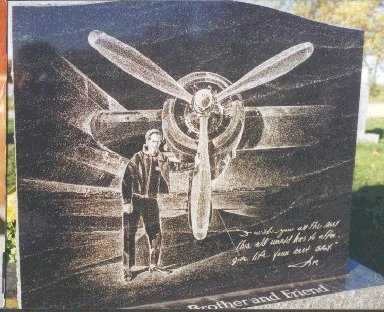 What
you see here is called an etching. Usually preformed on black
granite, once the polish of a stone is broken by a sharp point, it
will remain like that as long as the stone exists. The art form has
been around as long as dark stone has been employed. It is
photographic yet uniquely artistic because it requires an etcher to
create the image without blue print or tools other than a pointed
object and small mallet. I post an interesting tale about
etchings in Part II, don’t skip over it..This
etching was preformed by Bill Peisher, of Woodburn Monuments, N.Y.
What
you see here is called an etching. Usually preformed on black
granite, once the polish of a stone is broken by a sharp point, it
will remain like that as long as the stone exists. The art form has
been around as long as dark stone has been employed. It is
photographic yet uniquely artistic because it requires an etcher to
create the image without blue print or tools other than a pointed
object and small mallet. I post an interesting tale about
etchings in Part II, don’t skip over it..This
etching was preformed by Bill Peisher, of Woodburn Monuments, N.Y.
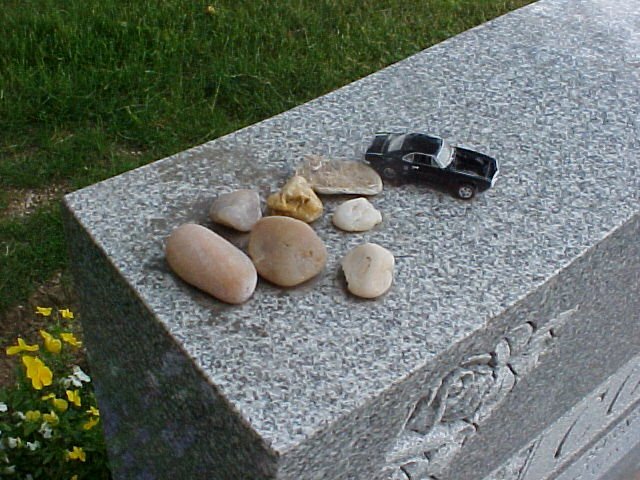 Leaving
Rocks. In ancient times most graves were tumuli (singular:
tumulus) a mound of earth and stones rasied over a grave(s). The idea
was to protect the body from animals as well as a means to locate and
identify the spot. You were expected to tend to the mound during
visits and that action is carried on today through a tradition often
seen at Jewish cemeteries, but almost anywhere. Stone will not
hurt stone – unless struck. But paints and especially
adhesives can permanently stain bronze, granite and marble
surfaces. In this photo we see a child’s toy that surely touches
our hearts. I imagine a child left it there as a token of his visit.
A cemetery worker might (and might not) remove it. However, if left
there over time the sun will melt the rubber wheels, rain will spread
the paint and the top of this monument will be indelibly marked.
Never affix anything at all to monuments and markers unless it is
properly doled and attached by a professional.
Leaving
Rocks. In ancient times most graves were tumuli (singular:
tumulus) a mound of earth and stones rasied over a grave(s). The idea
was to protect the body from animals as well as a means to locate and
identify the spot. You were expected to tend to the mound during
visits and that action is carried on today through a tradition often
seen at Jewish cemeteries, but almost anywhere. Stone will not
hurt stone – unless struck. But paints and especially
adhesives can permanently stain bronze, granite and marble
surfaces. In this photo we see a child’s toy that surely touches
our hearts. I imagine a child left it there as a token of his visit.
A cemetery worker might (and might not) remove it. However, if left
there over time the sun will melt the rubber wheels, rain will spread
the paint and the top of this monument will be indelibly marked.
Never affix anything at all to monuments and markers unless it is
properly doled and attached by a professional.
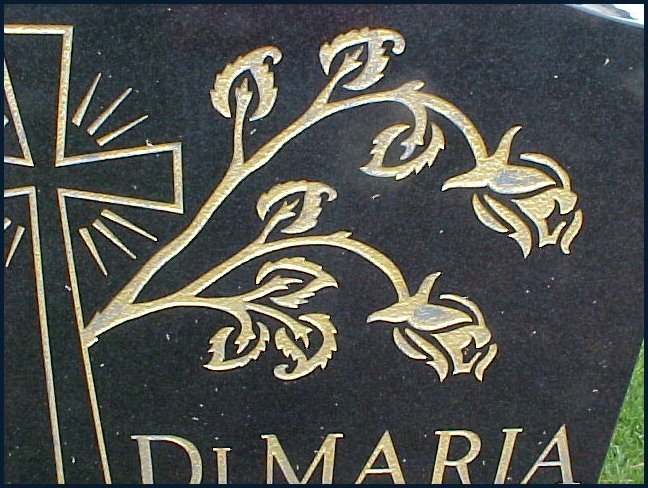 Gold
leaf is a good example. I am always astounded by claims from my
own industry that someone, somewhere can affix gold to stone and
guarantee it will last forever. Notably, most who claim this are near
the end of their career / life and greedy enough to grab the last
buck that’s lying around. Most builders will gladly attach gold
to stone, as long as you sign a wavier and understand it will fall
out eventually. The gold leafing in the DiMaria stone shown
here started to fall out before its fifth year. Stone and even bronze
circulates air and moisture. Pour a bucket of water over a small
monument and watch what happens. It will dry top down just like a
sponge. Nothing glued or painted to stone can fasten itself forever.
The water and air moving around in the stone itself will eventually
undo the foreign material.
Gold
leaf is a good example. I am always astounded by claims from my
own industry that someone, somewhere can affix gold to stone and
guarantee it will last forever. Notably, most who claim this are near
the end of their career / life and greedy enough to grab the last
buck that’s lying around. Most builders will gladly attach gold
to stone, as long as you sign a wavier and understand it will fall
out eventually. The gold leafing in the DiMaria stone shown
here started to fall out before its fifth year. Stone and even bronze
circulates air and moisture. Pour a bucket of water over a small
monument and watch what happens. It will dry top down just like a
sponge. Nothing glued or painted to stone can fasten itself forever.
The water and air moving around in the stone itself will eventually
undo the foreign material.