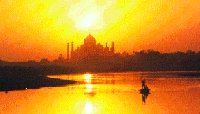
The Taj Mahal.
The Taj Mahal.
Not all monuments are built, and not all built by man. Some are eloquent parts of the planet like parks. Some are natural formations, which tell a story so vividly that a child can visualize the event, like a meteorite crater. But for the most part, it is up to us humans to assemble lasting materials together in order to speak to future generations and tell our story. And perhaps the most beautiful story and the most beautiful monument of them all is the Taj Mahal. The Taj Mahal represents the high point of Mogul architecture. In 1631 the wife of the Mogul emperor of India died giving birth to her 14th child. She was 36 years old and had been married for 18 years. Her Husband, Shah Jehran, had lost not only his beloved wife but also a shrewd political adviser and is said to have been in mourning for two years. He vowed to build a tomb worthy of his wife's memory, something utterly without equal anywhere in the world, and few would deny that he succeeded.
Arjumand Banu, otherwise known as Mumtaz
Mahal ("the Chosen One of the Palace") has as her memorial
an astonishing building which bears the abbreviation
of her name: Taj Mahal. So many
superlatives have been used to describe this monument that almost
everyone who visits it expects to be disappointed. No one ever is.
Besides the sheer majesty of the monument is the power of the love
Shah Jehran held deeply for his wife. And there is one other point,
over looked by laymen; everyone knows the story, sees the monument,
knows who ordered it built, but the architects are completely
unknown. It is often said in the stone trades that the Taj Mahal was
history's monument to the modern age. An age more personal than
before, more sincerity between the sexes and more focused on the art
of things than the artists.